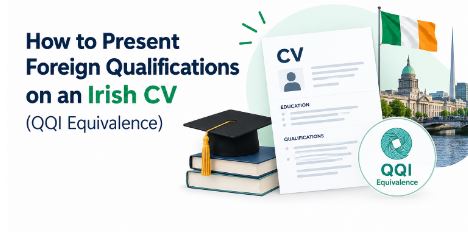
Moving to Ireland for work is exciting, but one practical problem trips up many newcomers: how to show their degree on a CV. A recruiter in Dublin or Cork may never have heard of your university, and they won’t know how your qualification compares with the Irish system. If they can’t judge its level at a glance, they may overlook it, even when you are highly qualified.

The solution is to present your qualifications in a way Irish employers understand, usually by referring to Quality and Qualifications Ireland (QQI) and the National Framework of Qualifications (NFQ). This guide explains how, step by step.
Why Foreign Qualifications Cause Confusion
Irish recruiters review large numbers of applications, often filtered first by applicant tracking software. They are used to seeing the Leaving Certificate, QQI awards, and honours degrees. Foreign qualifications vary in length, grading, and naming. A three-year bachelor’s degree in one country might compare to an Irish Level 7 or Level 8 depending on its content, and titles such as Licenciatura, Diplom, or B.Tech mean little to a local reader.
Without context, the recruiter has to guess, and most won’t take the time. Your job is to remove the guesswork.
Understanding QQI and the NFQ
QQI is the state agency responsible for quality assurance and qualifications in Irish education. The NFQ has ten levels:
- Level 6: Advanced certificate or higher certificate
- Level 7: Ordinary bachelor’s degree
- Level 8: Honours bachelor’s degree and higher diploma
- Level 9: Master’s degree and postgraduate diploma
- Level 10: Doctorate
QQI also runs a qualifications recognition service (previously known as NARIC Ireland) that compares foreign qualifications with the NFQ and issues recognition advice. Fees and processing times apply, and the process can change, so check QQI’s website for current details before you apply.
Step 1: Work Out Your Equivalent Level
Start by gathering your certificates, transcripts, and details of your course length, credits, and subjects. Then decide whether you need formal recognition advice.
Many employers accept a clear, honest description of your degree without any formal statement. Formal recognition becomes more useful if you are applying to the public sector, if an employer asks for it, or if your qualification is unusual. Keep in mind that recognition advice describes the level of your qualification. It doesn’t guarantee a job or professional registration.
Step 2: Format Your Qualifications Clearly
Place your education section where it best supports your application. Recent graduates usually lead with it, while experienced professionals tend to put it after their work history. For each qualification, include:
- The full title in English (with the original title in brackets if helpful)
- The institution and country
- Years attended
- Your grade or classification, with a short note on the grading scale
- The NFQ level, if you have confirmed it
For example:
Bachelor of Engineering (Electronics), University of Pune, India, 2014–2018
Grade: First Class (top classification)
Recognised by QQI as comparable to NFQ Level 8
If you haven’t obtained formal advice, use cautious wording such as “comparable to an Irish honours bachelor’s degree” rather than claiming an exact equivalent. Overstating a level can damage trust if an employer checks.
For grades, explain the scale rather than just quoting a number. “GPA 3.7/4.0” is clear, while “8.2” with no scale is meaningless to an Irish reader. Job seekers outside the capital can also find local support for this kind of detail, for example through cv making services in Sligo, where a writer can check how your grades and titles read to regional employers.
Step 3: Handle Regulated Professions Separately
Some careers require professional registration in addition to a recognised qualification. Examples include doctors, nurses, teachers, engineers, solicitors, and health and social care professionals. Each regulator, such as the Medical Council, the Nursing and Midwifery Board of Ireland, or the Teaching Council, has its own recognition process, and QQI advice doesn’t replace it.
If you work in one of these fields, show your registration status prominently, near the top of your CV. If your application is in progress, say so briefly, for example “Registration with the Teaching Council: application submitted.” This reassures employers that you are on the path to working legally in your profession.
Step 4: Explain Your Employers and Experience
Qualifications are only part of the picture. Irish recruiters may not recognise your previous employers either. Add a short line describing each organisation, such as “Leading telecoms provider in Poland, 2,000 employees”. This tells the reader the scale and sector without extra effort.
Describe your achievements in ways that travel well across borders. Use percentages, team sizes, and outcomes rather than local jargon, and convert currencies into euro where it helps. This matters most in fields where campaign or market experience abroad needs translating for an Irish reader, and marketing CV builders in Ireland can help you frame international results in terms local employers value. Keep to Irish conventions: no photograph, date of birth, or marital status, and a document of one to two pages.
Step 5: Polish the Language and Details
Present professional, clear English, and make sure every qualification title is translated accurately. If you speak other languages, list them with a level such as a CEFR rating, since multilingual candidates are valued by many Irish employers.
State your right to work in Ireland briefly, for example your permit or stamp, so the employer doesn’t have to ask. Keep this to one line near your contact details or in your profile.
Common Mistakes to Avoid
- Leaving out the country. A recruiter needs to know where you studied to judge the context.
- Claiming equivalence you haven’t confirmed. Use “comparable to” unless you have formal advice.
- Listing unexplained grades. Always include the scale or classification.
- Hiding foreign experience. Describe it, don’t minimise it. International experience is often an advantage.
- Using untranslated titles. If the reader can’t understand the qualification, it won’t help you.
- Sending a generic document. Tailor the CV to each role and its keywords.
Getting Professional Support
Many people manage this on their own, but presenting international credentials is one area where expert help pays off. Searching for resume writers near me is natural, though most of the work happens online, so prioritise sector knowledge and experience with the Irish market over postcode. A resume writing agency with experience of international candidates will know how to describe your qualifications and employers so they make sense locally.
Established resume makers in Ireland understand Irish formatting conventions and employer expectations, and the best team of resume writers will have a background in recruitment as well as writing. A dedicated CV writing service in Ireland can also help you balance honest equivalence statements with a persuasive overall story.
Online layout tools have their place, and a cv maker Ireland option may help with design, but a template can’t judge how to describe your degree or whether to mention recognition advice. When comparing the best resume writing website options, read independent reviews and ask who will actually write your document. It also helps to choose a provider offering resume writing and CV writing, as some roles, especially those linked to the US or multinational employers, may request one format or the other.
If a deadline is close, look for the fastest resume service that still includes a proper consultation and a revision round, rather than a quick reformat of your old document.
Final Thoughts
Foreign qualifications are an asset, not a barrier, as long as employers can understand them. Work out your NFQ equivalent, describe each qualification clearly, show professional registration where it applies, and explain your employers and grades in simple terms. Avoid overclaiming, keep the document concise, and tailor it to each role.Do this well, and your CV will show Irish recruiters not just where you studied, but exactly what you bring to the job.