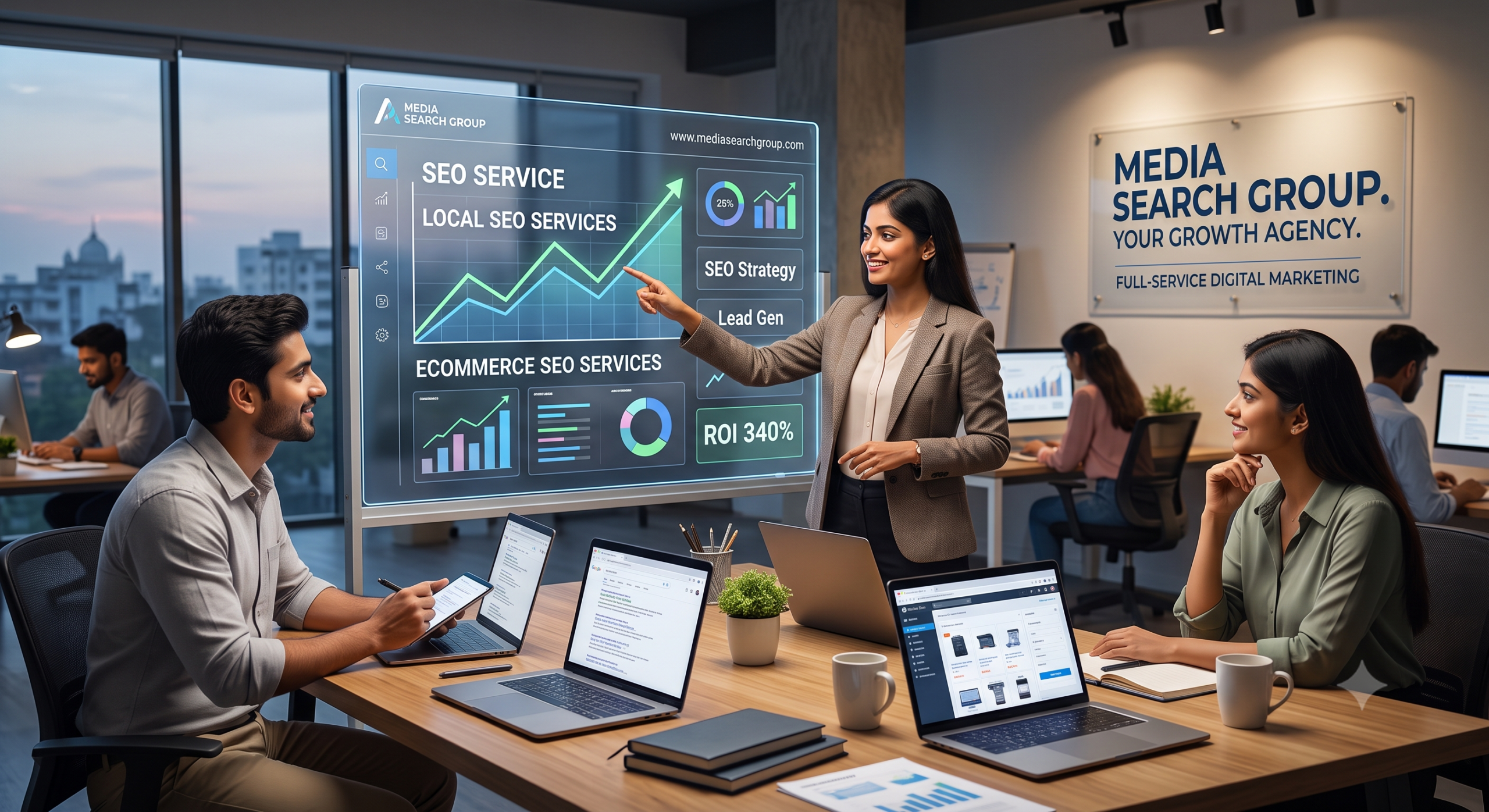
The way people discover and evaluate businesses has changed dramatically. Before contacting a company or purchasing a product, customers often search online, compare alternatives, read reviews, visit websites, check social media profiles, and look for evidence that a business can solve their problem (digital marketing agency).

For businesses, this creates both an opportunity and a challenge.
Being present online is no longer enough. A company needs to be visible when potential customers are searching, provide useful information when they are researching, create a smooth experience when they visit the website, and make it easy for them to take the next step.
This is why digital marketing has become an important part of business growth.
However, managing multiple channels can be difficult, particularly for small businesses and growing companies with limited internal resources. Search optimization, paid advertising, content creation, social media, analytics, ecommerce marketing, and conversion optimization all require different skills.
Working with a digital marketing agency can help businesses bring these activities together under a more structured growth strategy.
The objective should not simply be to increase online activity. A successful strategy should connect marketing efforts with measurable business outcomes.
Understanding the Modern Customer Journey
Customers rarely follow a single path from discovery to purchase.
Someone searching for a service may first encounter a blog article. Several days later, they may search for the company name, visit its website, look at reviews, and then click a paid advertisement.
An ecommerce customer might discover a product on social media, compare prices on Google, read product reviews, visit the website from an organic result, and eventually return through an email campaign.
This behavior means businesses need to understand the complete customer journey.
A strong digital strategy considers three broad stages:
Discovery
At this stage, potential customers may not know the business. They are searching for information, identifying problems, or exploring possible solutions.
Content marketing, SEO, social media, video, and online advertising can help businesses become visible.
Consideration
Customers now understand their problem and are evaluating potential solutions.
Comparison pages, product information, case studies, reviews, educational resources, and detailed service pages can help establish trust.
Conversion
The customer is ready to take action.
At this stage, landing pages, clear calls to action, simple forms, transparent pricing, easy checkout processes, and strong trust signals can influence the final decision.
Marketing becomes more effective when every stage has a purpose.
SEO Builds Long-Term Search Visibility
Search engines remain one of the most important discovery channels for businesses.
When people have a specific need, they often begin by searching for information, products, services, or businesses that can help them.
SEO helps businesses improve their visibility for these searches.
A comprehensive SEO strategy can involve:
- Technical website improvements
- Keyword research
- Search-intent analysis
- On-page optimization
- Content development
- Internal linking
- Website architecture
- Structured data
- Digital authority building
- Local optimization
- Performance monitoring
However, SEO should not be viewed simply as a process of inserting keywords into pages.
Modern search optimization is closely connected to relevance and usefulness.
A page needs to answer the searcher’s question effectively. It should be accessible, understandable, technically sound, and provide a good user experience.
Professional seo services can help businesses develop a consistent process for improving these areas over time.
Local Visibility Matters for Location-Based Businesses
A business serving a specific city, region, or service area needs a different search strategy from a company targeting customers worldwide.
Consider searches such as:
- restaurants near me
- marketing company in a specific city
- emergency plumber nearby
- dental clinic in a neighborhood
- home services in a particular location
These searches often have strong commercial intent.
Local search optimization helps businesses improve their visibility when customers are looking for nearby products or services.
A comprehensive local strategy may include:
- Business profile optimization
- Local keyword research
- Location pages
- Review management
- Citation consistency
- Local content
- Geographic relevance
- On-page optimization
- Local link-building opportunities
Businesses investing in local seo services should also pay attention to the overall customer experience. Accurate business information, positive reviews, clear contact details, and a professional website can influence whether a searcher decides to contact the company.
Local search is therefore not only about rankings. It is also about building confidence.
Content Marketing Can Build Authority
People do not always search online because they are ready to buy.
Sometimes they are trying to understand a problem.
For example, a business owner might search for ways to reduce advertising costs before looking for a marketing provider. An online shopper may research the difference between two product types before choosing a specific item.
Content gives businesses an opportunity to become useful before the customer is ready to purchase.
Effective content can include:
- How-to guides
- Industry articles
- Research reports
- Case studies
- FAQs
- Product comparisons
- Tutorials
- Videos
- Checklists
- Expert insights
The key is relevance.
Instead of producing content simply because a company has a blog, businesses should identify questions their target audience actually asks.
This can improve organic visibility while also supporting customers during the research stage.
Paid Advertising Can Accelerate Customer Acquisition
SEO can provide sustainable visibility, but organic growth usually takes time.
Paid advertising offers businesses another way to reach potential customers quickly.
Search advertising can be particularly useful when users are actively searching for products or services.
Paid campaigns can also support:
- New product launches
- Seasonal promotions
- Lead-generation campaigns
- Geographic targeting
- Remarketing
- Brand campaigns
- Competitive opportunities
However, successful advertising requires careful management.
Simply increasing ad spend does not guarantee better results.
Businesses should monitor metrics such as:
- Cost per click
- Conversion rate
- Cost per lead
- Customer acquisition cost
- Revenue
- Return on ad spend
- Landing-page performance
The landing page is particularly important.
An advertisement may attract the right audience, but if the landing page does not match the user’s expectations, conversions can suffer.
Ecommerce Growth Requires More Than Product Listings
Online retailers operate in a highly competitive environment.
Customers can compare products, prices, reviews, shipping options, and brands within minutes.
This makes ecommerce optimization particularly important.
An effective ecommerce seo strategy can improve the visibility and accessibility of product and category pages.
Important areas include:
- Product titles
- Product descriptions
- Category structures
- Search-friendly URLs
- Internal links
- Product images
- Structured data
- Technical performance
- Mobile experience
- Duplicate-content management
- Indexation
- Faceted navigation
But search visibility is only one part of ecommerce success.
Once customers reach the website, the store must make purchasing easy.
Product pages should answer important questions about features, specifications, pricing, availability, delivery, returns, and customer concerns.
Trust signals such as reviews and clear policies can also reduce hesitation.
Social Media Can Strengthen Brand Relationships
Social media provides businesses with an opportunity to communicate with audiences in a more direct and informal environment.
However, successful social media marketing is not simply about posting every day.
Businesses should determine what role social platforms play in their broader strategy.
Depending on the business, social media can support:
- Brand awareness
- Community building
- Product education
- Customer engagement
- Lead generation
- Content distribution
- Product discovery
- Customer support
A B2B company may use social media to share research and industry insights. A fashion brand might focus on visual storytelling and product discovery. A local business may highlight customer experiences and community activity.
The strategy should reflect the audience and the platform.
Website Experience Influences Marketing Performance
A business can invest heavily in generating traffic, but poor website usability can undermine those efforts.
Visitors expect websites to load quickly, work well on mobile devices, and make information easy to find.
Important website experience factors include:
- Page speed
- Mobile responsiveness
- Clear navigation
- Readable content
- Strong calls to action
- Simple forms
- Secure browsing
- Accessible contact information
- Easy checkout
- Clear product or service information
Website design should serve a purpose.
An attractive website is useful, but a website that helps visitors understand the offer and take action is even more valuable.
Conversion Optimization Improves the Value of Existing Traffic
Businesses often focus heavily on attracting more visitors while overlooking the visitors they already have.
Conversion optimization addresses this problem.
Suppose a website receives 20,000 monthly visitors but generates relatively few inquiries. Increasing traffic may help, but improving the conversion experience could potentially produce better results without requiring the same increase in acquisition costs.
Businesses can experiment with:
- Headlines
- Button text
- Page layouts
- Forms
- Images
- Testimonials
- Trust badges
- Product descriptions
- Pricing presentation
- Calls to action
Testing should be based on evidence rather than assumptions.
Analytics, heatmaps, user behavior data, and conversion tracking can help identify areas where improvements may have the greatest impact.
Analytics Makes Marketing More Accountable
Digital marketing produces a significant amount of data.
The challenge is deciding which information actually matters.
A business may track thousands of website visits, social media interactions, and advertising impressions. But these metrics do not necessarily explain whether marketing is generating profitable growth.
Businesses should connect marketing data with business objectives.
Useful metrics can include:
- Qualified leads
- Sales
- Revenue
- Conversion rate
- Customer acquisition cost
- Organic conversions
- Paid conversions
- Average order value
- Customer lifetime value
- Return on investment
For example, one campaign may generate 500 leads while another produces only 150. At first glance, the first campaign appears better.
But if the 150 leads produce significantly more customers and revenue, the second campaign may actually be more valuable.
This is why measurement should go beyond volume.
Why Different Marketing Channels Should Work Together
One of the biggest opportunities in modern marketing is integration.
SEO, content, paid advertising, social media, email, and conversion optimization can support one another.
Consider a company launching a new service.
The SEO team researches customer search behavior. The content team develops educational material. The website team creates a dedicated service page. Paid advertising generates immediate visibility. Social media distributes useful content. Analytics tracks interactions and conversions.
The information collected from one channel can also improve another.
Paid search data can reveal valuable keywords. SEO performance can identify topics worth promoting. Conversion data can improve ad messaging. Customer questions can inspire new content.
This creates a feedback loop where marketing becomes increasingly informed by actual customer behavior.
Looking Ahead: Digital Marketing Will Become More Integrated
The digital landscape will continue to evolve.
Search behavior is changing. Artificial intelligence is influencing how people discover information. Advertising platforms are becoming more automated. Ecommerce experiences are becoming increasingly personalized.
Yet businesses should not lose sight of the fundamentals.
Customers still want useful information, trustworthy businesses, fast websites, relevant offers, convenient purchasing experiences, and responsive communication.
Technology can make these experiences more scalable, but customer understanding remains at the center.
Businesses that combine data with creativity, technology with strategy, and acquisition with retention will be better positioned to adapt as digital channels continue to change.
Conclusion
A successful online presence is not created by using every available marketing channel. It comes from understanding customers and connecting the right activities to the right business objectives.
SEO can create long-term search visibility. Paid advertising can provide targeted reach. Content can educate potential customers. Social media can strengthen relationships. Ecommerce optimization can improve product discovery. Conversion optimization can turn more visitors into customers. Analytics can reveal which activities are actually contributing to growth.
When these elements operate together, digital marketing becomes a coordinated business strategy rather than a collection of disconnected tasks.
For startups, small businesses, ecommerce brands, and established companies alike, the focus should remain on sustainable growth, measurable outcomes, and better customer experiences.
The businesses that approach digital marketing strategically—rather than chasing every new trend—can build stronger online visibility and create a more reliable foundation for long-term growth.