
If you use your own car for work, this year’s rate change actually matters to your take-home pay. Cars and vans now claim at 55p per mile for the first 10,000 business miles, up from 45p the first change to this rate since 2011, backdated to 6 April 2026 even though HMRC didn’t confirm it until May.

That’s not a small adjustment. Someone driving 8,000 business miles a year now claims £4,400 instead of £3,600 an extra £800 in their pocket. Whether you’re an employee, a director, or running payroll for a small team, it’s worth understanding exactly how this works before your next claim goes in.
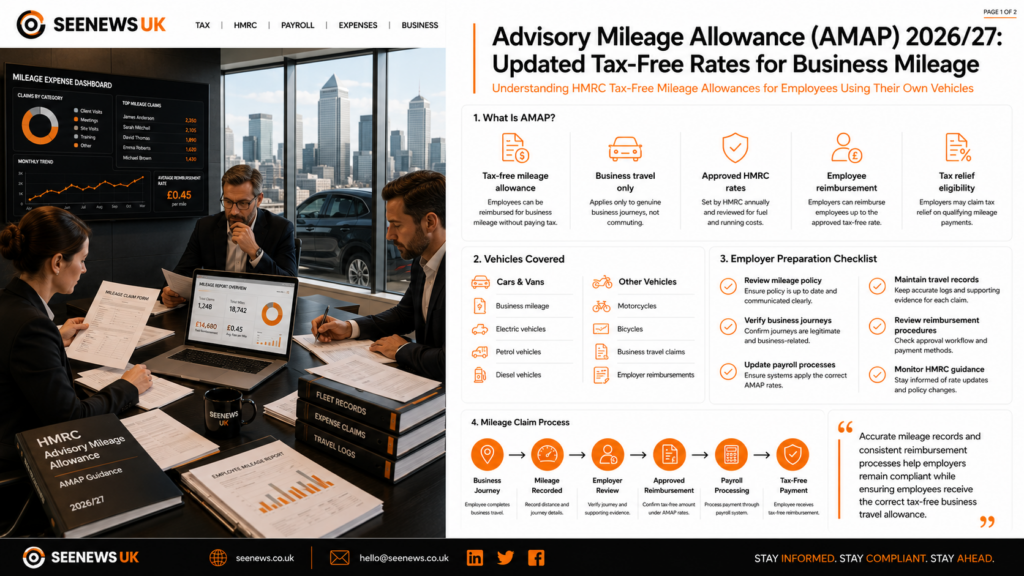
Quick answer: you can claim 55p per mile for the first 10,000 business miles in a car or van, then 25p after that. Motorcycles stay at 24p, bicycles at 20p. Pay or claim within these limits and there’s nothing to report to HMRC.
What Is the Advisory Mileage Allowance, Exactly?
AMAP is HMRC’s flat rate for reimbursing business travel in a personal vehicle. Rather than tallying up fuel, insurance, and wear separately, one pence-per-mile figure covers the lot.
Pay at or below the approved rate, and it’s tax-free for both sides, no benefit-in-kind, nothing to declare. Pay above it, and the excess becomes taxable. Simple enough once you see it laid out.
Key takeaway: AMAP replaces itemised vehicle expense tracking with one clean rate, as long as you stay within the approved limit.
What Changed for 2026/27?
Only the headline car and van rate moved. Everything else, motorcycles, bicycles, the 10,000-mile threshold, the passenger payment stayed exactly where it was.
| Vehicle | 2025/26 Rate | 2026/27 Rate |
| Car/van (first 10,000 miles) | 45p | 55p |
| Car/van (after 10,000 miles) | 25p | 25p |
| Motorcycle | 24p | 24p |
| Bicycle | 20p | 20p |
| Passenger add-on | 5p | 5p |
If an employee carries a colleague on a business journey, you can add a further 5p per mile per passenger. Electric and hybrid vehicles owned personally follow the same 55p/25p structure as petrol and diesel cars; there’s no separate AMAP tier for EVs. Company-owned EVs use a separate Advisory Electric Rate instead.
Who Can Actually Claim This?
Employees using their own car for work, sole traders, contractors, and company directors driving personal vehicles all qualify. Landlords inspecting rental properties can claim too, provided the trip is genuinely business-related.
Company car drivers are the exception. If your employer owns the vehicle, you’re working with Advisory Fuel Rates instead of a different system entirely, based on fuel type and engine size rather than a flat mileage figure.
What Counts as Business Mileage?
Client visits, travel between sites, and trips to a temporary workplace all qualify. Your regular commute between home and a permanent workplace never counts, no matter how far it is.
Hybrid workers trip up here often. A journey from home straight to a client counts as business mileage. The same journey from home to your usual office doesn’t even on a day you’d normally work from home.
Key takeaway: if the trip replaces your normal commute, it’s not deductible. If it’s genuinely additional business travel, it is.
What If Your Employer Pays Less Than 55p?
You can claim the shortfall yourself through Mileage Allowance Relief. Say your employer reimburses 40p per mile you can claim tax relief on the 15p gap for every business mile driven.
Pay above 55p, and the excess counts as a taxable benefit. That needs reporting through payroll or a P11D, and it attracts Class 1A National Insurance for the employer.
AMAP vs Other Mileage Systems
| System | Applies To | Basis |
| AMAP | Personal vehicle, any employee/self-employed | Flat pence-per-mile |
| Advisory Fuel Rates | Company car drivers | Fuel type and engine size |
| Mileage Allowance Relief | Underpaid employees | Claims the shortfall vs AMAP |
| Simplified expenses | Self-employed | Same rates as AMAP, no separate receipts needed |
Confusing AMAP with Advisory Fuel Rates is one of the most common mistakes finance teams make. They’re not interchangeable; one covers your own car, the other covers a company-owned one.
Here you can read our another blog: Universal Credit 420 boost Uk
Common Mistakes Worth Avoiding
Claiming ordinary commuting is the classic error, closely followed by patchy record-keeping. A mileage log needs a date, start and end point, purpose, and total miles for every trip, not a rough estimate reconstructed months later.
Plenty of people also assume every employer payment is automatically tax-free. It isn’t, once you go above the approved rate. And forgetting the passenger add-on means leaving money on the table for journeys where a colleague genuinely came along for business reasons.

Getting Your Mileage Claims Right
- Confirm which rate applies to your vehicle type
- Log every journey as it happens, not weeks later
- Check whether your employer’s rate matches the approved figure
- Claim Mileage Allowance Relief if you’re being underpaid
- Keep digital records for at least the current and previous tax year
Frequently Asked Questions
Does the 55p rate apply from the start of the tax year, or only from when it was announced?
It’s backdated to 6 April 2026, even though HMRC didn’t confirm the increase until May. So if you claimed mileage at the old 45p rate between April and the announcement, you’re entitled to the difference on every one of those miles. Worth checking your records from the start of the tax year rather than assuming only claims from the announcement date onward count.
Can I claim AMAP if I’m self-employed, or is that only for employees?
Self-employed people can absolutely use it, through what HMRC calls simplified expenses. Instead of tracking every fuel receipt, insurance payment, and repair bill separately, you apply the same 55p/25p structure to your business mileage and that becomes your deduction. It’s often simpler than itemising actual costs, especially if your mileage is moderate rather than very high.
If I do high annual mileage, is AMAP actually the best option, or should I claim actual costs instead?
It depends heavily on your mileage and your vehicle’s real running costs. At very high mileage, say 25,000 miles a year in a van, AMAP might work out to roughly £8,000, while actual costs like fuel, insurance, and servicing could easily exceed £12,000. If you’re self-employed and doing serious mileage, it’s worth running both calculations before picking a method, since you generally can’t switch freely once you’ve chosen one.
Do I need to charge my employer VAT-inclusive rates, or does VAT work differently with mileage claims?
VAT doesn’t work off the full 45p or 55p figure. It only applies to the fuel portion of the payment, using HMRC’s separate Advisory Fuel Rates. So a VAT-registered business reclaiming VAT on mileage payments needs to calculate that fuel-only element separately, and keep fuel receipts covering at least that much spend to support the claim.
What happens if I switch from a company car to using my own vehicle partway through the year?
You’ll move from Advisory Fuel Rates to AMAP from the point the change happens, and the two systems don’t blend together. Keep separate mileage logs either side of the switch, since HMRC will expect clear records showing which rate applied to which journeys, particularly if you’re claiming Mileage Allowance Relief for any shortfall on the AMAP side.
Final Thought
The rate increase is genuinely good news, but it only helps if your claims and records are accurate.
That’s where Seenews UK comes in reviewing your mileage policy, checking employer reimbursement rates against the current approved figures, and helping you or your team claim exactly what’s owed. Reviewing your mileage policy now, before the next payroll run or Self Assessment deadline, means nothing gets left on the table and nothing HMRC will query later.